The Ancestor of the Digital Age - Colossus to Receive Prestigious IEEE Milestone Honour
/
"The Ancestor of the Digital Age": Colossus to Receive Prestigious IEEE Milestone Honour at The National Museum of Computing
BLETCHLEY, UK – 17th June 2026 – The National Museum of Computing (TNMoC), located on the Bletchley Park estate, is proud to announce that IEEE, a public charity and the world’s largest technical professional organization advancing technology for the benefit of humanity, has officially approved the designation of the Colossus Computers (1944-1945) as an IEEE Milestone.
The IEEE Milestone Program recognises Colossus as one of the most significant technical achievements in computer history. The Milestone plaque will be officially unveiled during a landmark dedication ceremony at the Museum on Tuesday, 29 September 2026, held in conjunction with the 2026 Tony Sale Award for Computer Conservation.
The Machine That Shortened the War
Designed by the visionary Thomas H. Flowers (Tommy Flowers of the British Post Office), Colossus was the world’s first successful large-scale application of digital electronics to computing. While the legendary Bombe tackled Enigma, Colossus was built for an even greater challenge: breaking the "Tunny" code used for high-level teleprinter communications between Hitler and his High Command.
Operating in secrecy within Block H—where the Museum stands today—six Colossus machines enabled the Allies to read encrypted radio messages across occupied Europe, North Africa, and the Soviet Union. The intelligence gathered is credited with saving countless lives and significantly shortening the Second World War.
The official IEEE citation, which will be cast in bronze and permanently displayed at the Museum, states:
"The resulting military intelligence saved countless lives and helped shorten World War II. As the first successful large-scale application of digital electronics to computing, Colossus anticipated subsequent computer developments."
From Total Secrecy to Global Recognition
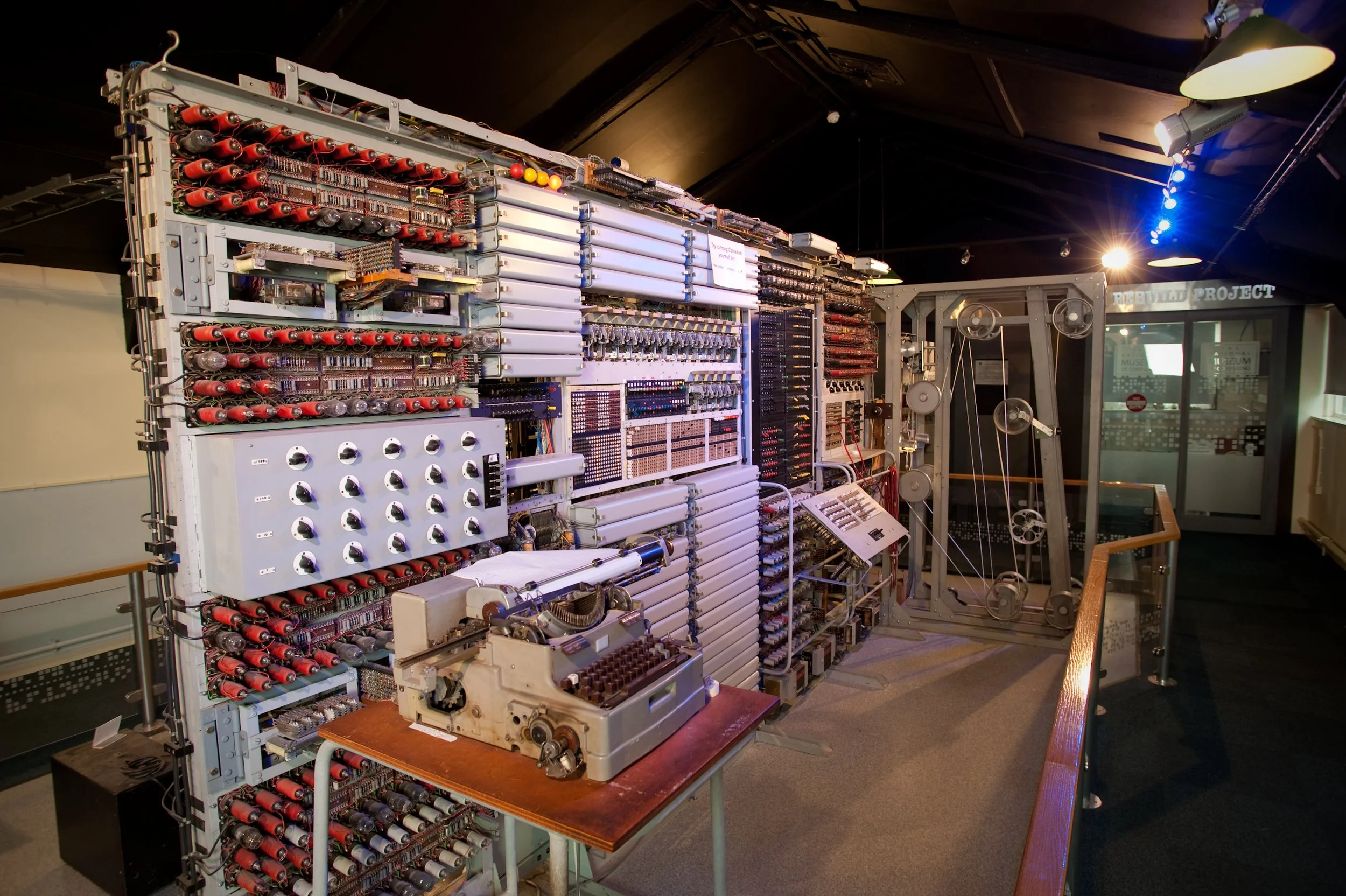
For decades, the existence of Colossus was a state secret; its blueprints were burnt and its components destroyed to maintain post-war security. It was only through the tireless work of the late Tony Sale and his team of volunteers that a fully functional rebuild was completed in 2004, allowing the public to finally witness the birth of electronic computing.
By becoming an IEEE Milestone, Colossus joins an elite group of world-changing technical innovations, including the technologies behind the Apollo Moon Landing, the birthplace of the Internet, and the first Transatlantic Television Transmission. This honour cements the legacy of the engineers, such as Tommy Flowers, and the many Wrens (Women's Royal Naval Service) who operated these massive machines 24 hours a day under immense pressure.
Dr Andrew Herbert Chairman of The National Museum of Computing
“We at The National Museum of Computing are honoured to receive an IEEE Milestone in recognition of our home, Block H at Bletchley Park, the last surviving building housing World War II Colossus machines. The machines work provided vital intelligence that helped shorten the war and save lives. For us Colossus is also the beginning of the British history that we tell in our museum through working original machines and carefully researched reconstruction. We are proud of our own reconstructed Colossus, the result of a fifteen-year effort by Tony Sale, one of our founders, and his team. We delight in showing it to our visitors and explaining how Bletchley Park was the birthplace of British computing.”
Professor Brian Randall
“The series of interviews that the authorities allowed me to conduct with Tommy Flowers and his colleagues in 1975/6 remain fresh in my memory. It was a wonderful privilege to help uncover and publicize the first declassified details of their amazing wartime work. Subsequently, the (carefully vetted) lecture that I was permitted to give on the Colossus at the International Research Conference on the History of Computing, held at Los Alamos in June 1976, and the additional Q & A evening session that was hurriedly-scheduled after my lecture, caused an absolute sensation. How could they not?
I had arranged to be accompanied to the Conference by Doc Coombs. He had been Tommy Flowers' successor in charge of the later stages of the Colossus project, and happened to be on vacation in the States at the time of the conference. Doc answered many of the barrage of questions at the evening session, while I (at Tommy Flowers' request) tried to ensure that Doc did not let his enthusiasm cause him to reveal any still-classified details of the Colossus machines and their use.
Since then, much more information has in fact been released and, through the heroic efforts led by the late Tony Sale, Colossus itself has been re-born here at Bletchley Park! I am very proud to have played a part in helping to ensure that Tommy Flowers and his Colossus have at last started to gain the recognition they richly deserve.”
Event Schedule: 29 September 2026
The dedication ceremony will serve as a global celebration of computer conservation and heritage:
10:30 AM: Museum galleries open for a "free-flow" tour, featuring the working Colossus rebuild.
12:15: Complimentary buffet lunch for registered guests and dignitaries.
13:15: Official IEEE Milestone unveiling followed by the Tony Sale Award for Computer Conservation presentation.
14:00:Tony Sale Award for Computer Conservation presentation.
Global Access: For those unable to attend in person, the ceremony will be livestreamed globally via the Computer Conservation Society (CCS).
About The National Museum of Computing
The National Museum of Computing (TNMoC) is an independent charity located on the Bletchley Park estate. It houses the world's largest collection of functional historic computers, including the rebuilt Colossus, the Turing-Welchman Bombe, and the WITCH (the world's oldest original working digital computer). The Museum’s mission is to conserve computing heritage and inspire the next generation of engineers.
About IEEE
IEEE is a public charity and the world’s largest technical professional organization dedicated to advancing technology for the benefit of humanity. Through its highly cited publications, conferences, technology standards, and professional and educational activities, IEEE is the trusted voice on a wide variety of areas ranging from global standards, aerospace systems, computers and telecommunications to biomedical engineering, electric power, and consumer electronics. Learn more at https://www.ieee.org.
About the IEEE Milestones Program
IEEE’s Milestones Program recognizes significant achievements in the history of IEEE fields of interest by placing bronze plaques where they occurred. It is a program of the IEEE History Committee, administered through the IEEE History Center. IEEE Milestones recognize the technological innovation and excellence for the benefit of humanity found in unique products, services, seminal papers and patents. Milestones honour the achievement, rather than a place or a person.